
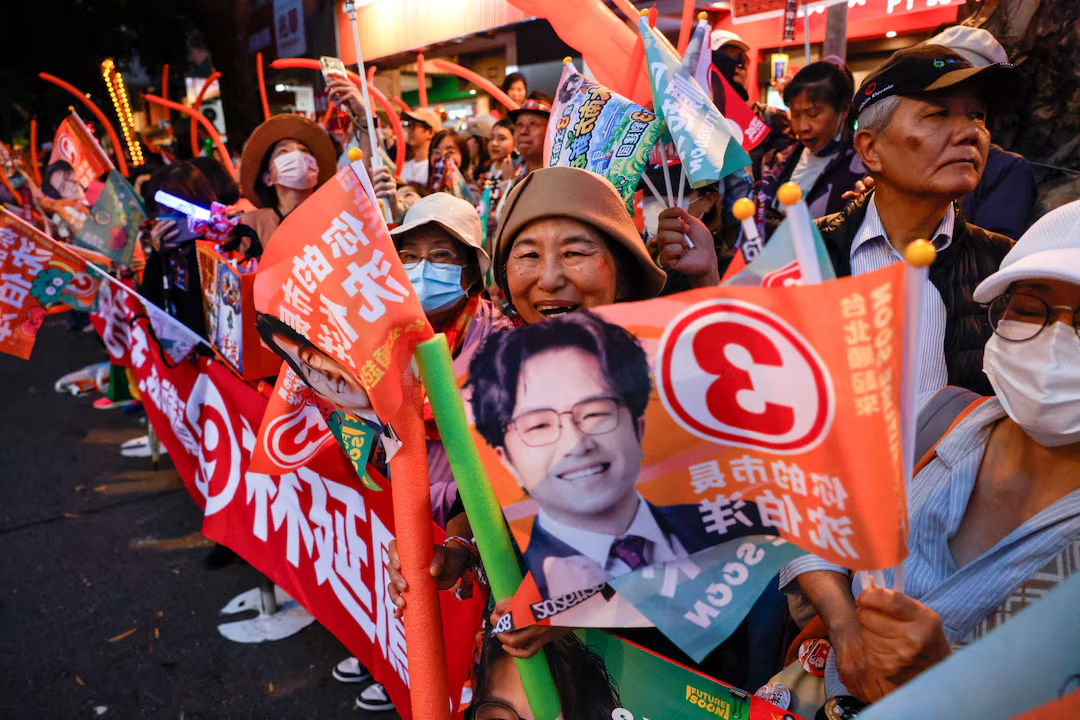
Taiwan’s elections are being fought over local issues such as housing, wages, transport and public services. Yet behind the campaign trail lies a much larger struggle: the attempt by the Chinese Communist Party (CCP) to shape Taiwan’s political environment from outside the island.
As Taiwan goes to the polls on November 28, 2026, Chinese interference has become more sophisticated, more technological and harder to detect. Beijing is no longer relying only on loud propaganda or military threats. Its methods increasingly operate through social media, cyberattacks, artificial intelligence, economic incentives, covert networks and psychological pressure.
Taiwan’s National Security Bureau (NSB) reported that more than 2.5 million pieces of disputed or false China-originated online information targeted Taiwan during the first nine months of 2026 — a roughly 48% increase from the same period the previous year. The material focused on issues including energy, food security, defence and individual election candidates.
The scale is significant because the objective is not necessarily to tell Taiwanese voters whom to support. It can be enough to make them distrust their government, distrust the media, distrust democratic institutions — or simply lose faith in voting itself.
From disinformation to cognitive warfare
Beijing’s information operations have evolved well beyond conventional propaganda.
Taiwanese authorities have identified the use of fake accounts, content farms, coordinated online comments, AI-generated videos and troll networks to amplify narratives favourable to Beijing and attack Taiwan’s government. Chinese state media can introduce a narrative, which is then amplified through other networks until it appears to be genuine public sentiment.
The strategy is particularly dangerous because fake accounts do not always begin with politics.
Some accounts reportedly build credibility by posting about food, celebrities, animals or ordinary daily life before introducing political messages. Others impersonate supporters of Taiwan’s ruling Democratic Progressive Party (DPP), helping pro-China narratives appear to come from within the political camp they are attacking.
The message can be remarkably simple:
The government is corrupt. Taiwan is unsafe. America cannot be trusted. Nothing will change. Voting is pointless.
The goal is to create political exhaustion and distrust.
That is not ordinary political campaigning. It is an attempt to manipulate the information environment in which voters make their decisions.
AI is giving Beijing a new weapon
Artificial intelligence is making these operations cheaper, faster and increasingly difficult to identify.
Taiwanese officials have warned that Beijing is using AI to study Taiwanese political developments, candidates, policies and polling information and then tailor influence operations toward specific audiences.
Recent investigations have also uncovered China-linked networks producing large volumes of fabricated videos attacking Taiwanese politicians. BBC Verify reported that a China-linked network had circulated more than 500 fake videos targeting the DPP over the preceding year, including fabricated material involving President Lai Ching-te and Taipei mayoral candidate Puma Shen.
The danger is not simply that voters may believe one fake video.
It is that thousands of pieces of manipulated content can flood the information space until citizens no longer know what is real.
That creates an environment in which truth itself becomes politically weakened.
Beijing is also using money, travel and influence networks
The CCP’s election strategy does not stop at the internet.
Taiwan’s security authorities have identified several alleged methods of attempting to influence voters, including illegal financial support for political candidates or groups, discounted travel to China, subsidised flights bringing Taiwanese citizens back from China to vote, disinformation and cyberattacks aimed at gathering election-related intelligence.
The use of travel incentives is particularly revealing.
Taiwanese citizens living or working in mainland China can still participate in elections. Taiwan’s authorities have warned that Beijing-linked actors may attempt to use subsidised transportation to encourage particular groups to return to Taiwan and vote for candidates favourable to Beijing.
This illustrates the broader strategy: influence does not have to look like interference.
It can be presented as business, travel, friendship, cultural exchange or economic opportunity while serving a political purpose.
Military pressure is part of the political environment
Beijing’s pressure on Taiwan also extends beyond elections themselves.
China has repeatedly conducted military exercises and other grey-zone activities around Taiwan. Taiwan regards these actions as part of a broader campaign designed to pressure its population and government.
The effect is psychological as well as military.
When voters are repeatedly confronted with Chinese military aircraft, naval vessels, cyberattacks and warnings about war, political choices can become entangled with fear.
Beijing’s message is effectively:
Choose carefully — because China is watching, and the consequences may be severe.
That is precisely why military pressure and information warfare cannot always be examined separately. Together, they can create a political environment in which voters are encouraged to prioritise accommodation with Beijing out of fear of escalation.
Cyberattacks add another layer of danger
Taiwan is also facing a persistent cyber threat.
Taiwan’s National Security Bureau reported an average of approximately 2.58 million cyber-intrusion attempts against government systems every day during the first nine months of 2026. Detected threats surged during the summer, including more than 185 million attempts in July. Taiwanese authorities said they could not rule out the possibility that some activity represented intelligence gathering or preparation for interference surrounding the elections.
Cyber operations can serve multiple purposes.
They can steal information, probe government systems, identify vulnerabilities, target political organisations or simply create uncertainty about whether critical infrastructure can withstand a crisis.
Taiwan has already experienced the scale of the threat. Research on the 2024 presidential election found a dramatic increase in malicious cyber activity around election day, while Taiwan has repeatedly reported Chinese-linked cyber and disinformation activity.
The CCP’s objective goes beyond one election
The most important point is that Beijing does not necessarily need to control the outcome of a single election.
Its broader objective is to reshape Taiwan’s political choices over time.
For decades, the CCP has refused to accept Taiwan’s democratic self-government and continues to claim sovereignty over the island. Beijing therefore has a strategic interest in weakening political forces that resist its demands while strengthening voices more willing to accommodate Chinese interests.
Research into CCP political warfare targeting Taiwan has identified a combination of fake opinion polls, United Front operations, AI propaganda, economic inducements and coercion, and military grey-zone pressure. Such interference has been a recurring feature of Taiwan’s elections since the island’s first direct presidential election in 1996.
This makes the 2026 elections about more than mayors and county magistrates.
They are also a test of whether Taiwan’s democratic institutions can withstand sustained pressure from an authoritarian power that has enormous economic, technological, military and informational resources.
Taiwan is not powerless
Beijing’s campaign has also produced a strong Taiwanese response.
Taiwan has established election-security mechanisms, strengthened cooperation among government agencies, increased monitoring of foreign information manipulation and supported fact-checking and media-literacy initiatives. Civil society organisations have become increasingly important in identifying fabricated content and tracing coordinated information campaigns.
But the challenge remains enormous.
Taiwan has to defend its democracy without destroying the openness that makes that democracy worth defending.
That is the fundamental advantage Beijing is trying to exploit.
An authoritarian state can control information at home. A democracy cannot — and should not — simply respond by controlling its citizens’ information in the same way.
Instead, Taiwan has to make its citizens harder to manipulate by making its institutions more transparent, its media more resilient and its public more capable of recognising foreign influence.
A warning for democracies beyond Taiwan
Taiwan may be the immediate target, but the methods being tested there have implications far beyond the island.
AI-generated propaganda, fake grassroots accounts, cyberattacks, economic inducements and covert political influence can be deployed against any open society.
Taiwan is therefore functioning as a frontline laboratory for a new form of political warfare — one in which the attacker does not need to occupy territory to interfere with democracy.
The CCP’s campaign demonstrates a troubling reality: an election can be attacked without a single ballot box being touched.
The attack can happen through a smartphone, a fabricated video, a hacked database, a subsidised flight, a fake social-media personality or a carefully timed military exercise.
Taiwan’s voters will ultimately decide their own future. But the fact that Beijing is working so aggressively to shape the environment in which they make that decision is itself a warning.
The threat to Taiwan’s democracy is not only about who wins an election. It is about whether Taiwanese voters remain free to decide without an authoritarian power trying to decide the choices for them.