


Who Will Teach AI About Tibet? The Hidden Stakes of the US China AI...
The new artificial intelligence dialogue between the United States and China may appear distant from Tibet, but it raises an important question for Tibetans: who will teach future AI systems about Tibet?

“Trump and Xi Discuss Taiwan, Iran and AI, But Where Was Tibet?”
If Tibet is not raised when Xi Jinping is sitting directly across from the President of the United States, when will it be?

Xi Jinping’s US Visit Met by Tibetan and Uyghur Protests Across Washington
Chinese President Xi Jinping’s state visit to the United States was met by sustained protests from Tibetans, Uyghurs and other groups in Washington, with demonstrators using the high profile summit to press human rights concerns as Xi met President Donald Trump.

Chinese Communist Party Names Hu Changsheng TAR Party Chief, Bringing a Record of Monastery...
China has appointed Hu Changsheng as Communist Party secretary of the Tibet Autonomous Region (TAR), replacing Wang Junzheng in the region’s most powerful political position. The appointment brings to Lhasa an official whose experience includes governing Tibetan areas and advancing policies that place religious institutions under closer Party supervision.

Ahead of Xi’s Washington Visit, US Congressional Hearing Puts Tibet, Uyghurs and Hong Kong...
As Chinese President Xi Jinping prepares to visit Washington later this month, a US congressional hearing has placed Tibet and China’s broader human-rights record directly into the conversation surrounding his visit.

Europe’s €1 Billion-a-Day China Trade Deficit Has Reached a “Tipping Point,” von der Leyen...
“Our trade deficit with China is now €1 billion a day. It has reached a tipping point,” von der Leyen said in her 2026 State of the Union address to the European Parliament on September 16.

Chinese Communist Party seeking to “weaponize” exit and entry rights
Travel restrictions have been used to punish dissidents and their families, suppress ethnic minorities and reinforce political control.

Xi Jinping’s BRICS Visit Puts Tibet Back in the Spotlight
Prime Minister Narendra Modi and Xi agreed that India and China should approach their relationship from a “strategic and long term perspective” and ensure that “differences should not become disputes.”
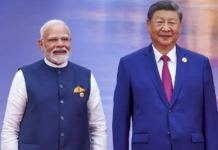
Xi’s India Visit: Why Modi Must Engage China—Without Trusting the CCP
New Delhi must remain wary of attempts to separate trade from border security, use BRICS solidarity to suppress legitimate Indian concerns or present temporary tactical accommodation as permanent strategic friendship.

China Penalizes Internet Users Over Alleged Rumors Following Tibet Mudslide
Chinese authorities have penalized multiple internet users accused of spreading false casualty figures following the devastating August 26 mudslide at Kyirong Port on the China-Nepal border.