
Since the founding of the People’s Republic of China in 1949, the state has consistently framed its actions in terms of stability, unity, and development. Yet across decades, a parallel record has emerged one documented in eyewitness accounts, internal reports, and international investigations showing repeated use of force against civilian populations, not only in Tibet, but also in Xinjiang and within China itself.
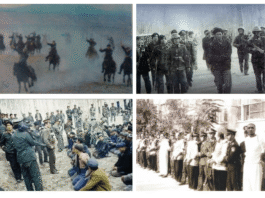
In 1950, the People’s Liberation Army (PLA) entered Tibet. Within less than a decade, tensions escalated into open resistance. By 1958, in Qinghai’s Xunhua region, PLA forces responded to local unrest by opening fire on civilians. Historical accounts indicate hundreds killed and thousands detained, marking one of the first large-scale crackdowns on Tibetan populations under Chinese rule.
The following year, 1959, saw the Lhasa uprising. Thousands of Tibetans gathered amid fears of political repression and threats to religious leadership. The PLA response was overwhelming. Reports describe heavy shelling, civilian casualties, mass arrests, and widespread destruction. Tens of thousands fled, including the Dalai Lama, while those who remained faced intensified political control.
What followed was not a return to normalcy, but the institutionalization of coercion.In 1962, the 10th Panchen Lama, a senior Tibetan figure within the Chinese system, submitted a detailed petition to Beijing. He documented widespread abuses during political campaigns:
– Beatings and torture of civilians
– Public humiliation during “struggle sessions”
– Arbitrary imprisonment and deaths in custody
His account is significant precisely because it came from within the system not from exile or foreign observers.
During the Cultural Revolution (1966–1976), violence expanded across all of China, but in Tibet it took on both political and cultural dimensions. Monasteries were destroyed, religious practice was criminalized, and civilians especially monks and community leaders were subjected to physical violence, forced labor, and imprisonment. Thousands of religious sites were dismantled during this period.
The use of force did not end with Mao-era campaigns.In 1989, Lhasa again witnessed protests. Martial law was imposed, and security forces were deployed across the city. Reports documented shootings, arrests, and suppression of civilian gatherings.
Nearly two decades later, in 2008, protests spread across Tibetan regions. Demonstrations were met with a coordinated security response. Human rights groups reported deaths, disappearances, and mass detentions, with thousands taken into custody many without formal charges or access to legal counsel.
While Tibet represents one trajectory, Xinjiang presents another larger in scale, more technologically controlled, and more recent in its peak intensity.
Beginning around 2017, Chinese authorities established a system of mass detention facilities in the Xinjiang Uyghur Autonomous Region (XUAR). Multiple sources, including the United Nations Office of the High Commissioner for Human Rights (OHCHR), have stated that the scale of detention may constitute serious human rights violations, potentially crimes against humanity.
Estimates suggest that over one million Uyghurs and other Turkic Muslims have been detained. Former detainees and investigations describe:
– Physical abuse and coercion
– Political indoctrination
– Severe restrictions on religious practice
– Separation of families
In addition, there are documented concerns about forced labor programs, surveillance systems using biometric data, and widespread restrictions on cultural and linguistic expression.
Violence and coercion have not been limited to ethnic minority regions.Within mainland China, the state has also used force against its own citizens during periods of unrest.
The most widely documented example remains June 4, 1989 — Tiananmen Square, Beijing.
What began as student-led protests calling for reform ended with a military crackdown. Troops entered the capital, and live ammunition was used against civilians. Casualty figures remain disputed, but independent estimates range from hundreds to potentially thousands killed.
In more recent years, similar patterns have appeared in different forms. In Hong Kong (2019–2020), protests were met with heavy policing, mass arrests, and the introduction of the National Security Law, which significantly expanded state control over political expression.
Across mainland China, reports from rights organizations have documented:
– Detention of activists and lawyers
– Use of physical coercion during interrogations
– Suppression of protests related to labor, land disputes, or public health measures
– Even localized incidents such as protests against lockdowns or financial fraud—have, at times, been met with forceful dispersal and detention.
Across these different regions and time periods, several consistent patterns emerge:
– Civilian dissent is framed as a security threat
– Military or paramilitary force is used to suppress unrest
– Mass detentions follow periods of protest
– Physical violence and coercion are documented in custody
– Independent accountability mechanisms remain limited
Official narratives continue to emphasize development, poverty alleviation, and stability. Infrastructure has expanded, and economic indicators have improved in many regions.
But the historical record shows that these developments have often occurred alongside strict political control and repeated use of force against civilians.
From Tibet (1950s–present)
to Xinjiang (2017–present)
to Beijing (1989)
and beyond the pattern is not isolated.I t is systemic. And it remains central to understanding the nature of state power in modern China.