
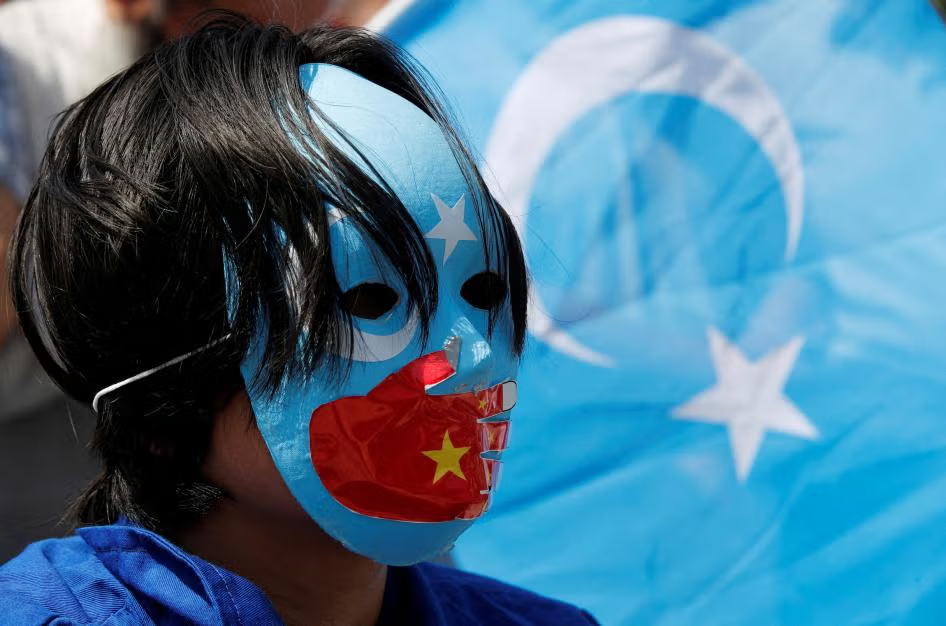
The 93rd anniversary of the first East Turkistan Republic and the 82nd anniversary of the second recall two experiments in independence and the continuing struggle over the rights, identity and future of Uyghurs under Chinese rule.
November 12 marked two significant anniversaries in Uyghur history: the proclamation of the first East Turkistan Republic in 1933 and the establishment of the second in 1944. For independence advocates, these dates represent a history of statehood that challenges Beijing’s account of the region. This year’s commemorations also come amid continuing concern over arbitrary imprisonment, religious repression, family separation and policies that the United States government and an independent people’s tribunal have determined constitute genocide. The Center for Uyghur Studies explicitly marked the 93rd and 82nd anniversaries in its November 12 statement.
The anniversaries connect two questions that are closely related for many Uyghur campaigners but legally distinct: the historical struggle for self-government and the contemporary responsibility to prevent atrocities. Independence organizations describe Chinese control as occupation or annexation and seek the restoration of East Turkistan’s sovereignty. Human rights investigations, meanwhile, examine the treatment of people living in the region regardless of its political status. The East Turkistan Government in Exile has made restoration of independence central to its commemorations.
The first republic emerged in Kashgar in November 1933 during a period of warlord rule, competing rebellions and profound instability following the collapse of the Qing dynasty. Often called the Turkish Islamic Republic of East Turkistan, it was short-lived, collapsing in 1934. Its importance to later generations lies partly in its assertion that the region’s predominantly Muslim Turkic peoples could establish their own political institutions. Its existence should not, however, be confused with uninterrupted control over the whole territory now administered as Xinjiang.
The second republic arose in November 1944 around Ghulja, also known as Yining, in the region’s northwest. It developed under different circumstances and with substantial Soviet support. Historian Jamil Hasanli’s examination of Soviet archives describes a de facto independent state whose trajectory was deeply influenced by Moscow. Soviet mediation subsequently helped produce an agreement with the Chinese government in 1946. The political and military order associated with the republic continued until the Communist takeover in 1949.
These distinctions matter. The two republics were separate projects, with different leaderships, alliances and territorial reach. Their histories cannot accurately be compressed into a single independent state that existed continuously from 1933 to 1949. Nevertheless, they remain powerful evidence of organized movements for self-rule and an enduring source of national memory.
Today, the dispute extends to the region’s name. “East Turkistan” expresses a historical homeland and, for independence advocates, a claim to sovereignty. Beijing rejects that political claim and administers the territory as the Xinjiang Uyghur Autonomous Region. Describing the 1949 incorporation as annexation reflects the position of independence organizations; it should be attributed as such rather than presented as an uncontested international judicial finding. China’s government rejects accusations that its rule and policies constitute colonial oppression or genocide.
The immediate human rights crisis intensified decades after the republics disappeared. Human Rights Watch traces the recent escalation through the 2014 “Strike Hard” campaign and the appointment of Chen Quanguo as regional Communist Party secretary in 2016. From 2017, authorities detained an estimated one million Uyghurs and other predominantly Muslim people in political education facilities. That widely cited estimate concerns the mass-internment campaign; it is not a verified count of people currently held in camps.
Beijing characterized the facilities as vocational education and training centers intended to combat extremism. Investigations challenged that description. Amnesty International’s 2021 report drew on former detainees’ accounts, other firsthand testimony, satellite imagery and additional evidence. It concluded that authorities had committed at least the crimes against humanity of imprisonment, torture and persecution. Its documentation described a system in which people could be targeted for ordinary activities and associations, including religious practice, overseas connections and communications with relatives abroad.
Leaked documents provided another route into a system largely closed to independent inspection. The International Consortium of Investigative Journalists’ China Cables investigation examined internal instructions and surveillance records, exposing the administrative machinery behind mass internment and the use of technology to identify people for investigation and detention. The significance of such material is that the evidence does not rest solely on outside political accusations: it also includes documents describing the authorities’ own operations.
The United Nations human rights office delivered its principal assessment on August 31, 2022. It found serious human rights violations and concluded that the scale of arbitrary and discriminatory detention, alongside wider restrictions on fundamental rights, “may constitute international crimes, in particular crimes against humanity.” It also found allegations of patterns of torture and ill-treatment credible, as well as allegations of individual incidents of sexual and gender-based violence. That assessment was not a criminal judgment, but it substantially strengthened the international evidentiary record.
The word “genocide” requires a separate explanation. Under the 1948 Genocide Convention, the crime involves specified acts committed with intent to destroy, wholly or partly, a protected national, ethnic, racial or religious group. Those acts include killing and causing serious bodily or mental harm, but also measures intended to prevent births and the forcible transfer of children. A genocide determination therefore does not depend exclusively on evidence of mass killing; the required intent remains central.
In January 2021, US Secretary of State Mike Pompeo determined that China had committed genocide and crimes against humanity against Uyghurs and other ethnic and religious minorities in Xinjiang. The determination cited practices including forced sterilization, arbitrary imprisonment, forced labor and restrictions on religious freedom. This was a governmental determination, with diplomatic and policy significance, rather than a conviction delivered by an international criminal court.
The London-based Uyghur Tribunal separately concluded in December 2021 that genocide had been committed, with its finding focusing particularly on measures intended to prevent births. Chaired by barrister Geoffrey Nice, the tribunal examined witness testimony and documentary evidence. It was an independent people’s tribunal, however, without the jurisdiction or enforcement powers of a state or international court. Its findings should be reported with that institutional distinction intact.
The UN human rights office’s assessment did not make a genocide determination. Reporting that “the UN ruled China committed genocide” would therefore misrepresent its findings. The US determination, the tribunal’s judgment and the UN assessment differ in their mandates and conclusions, even though all address evidence of severe abuses against Uyghurs and other predominantly Muslim communities.
The consequences extend beyond detention facilities. In September 2023, UN experts raised concerns about the expansion of state boarding schools, separation of Uyghur and other minority Muslim children from their families, and education that failed to provide adequate instruction in their mother tongue. They warned of a risk of forced assimilation. These concerns concern the ability of families and communities to transmit language, faith and cultural knowledge between generations. They do not establish that every boarding-school placement has identical circumstances, but they identify serious systemic risks.
The alteration of public memory is another documented concern. In 2024, Human Rights Watch and Uyghur Hjelp identified approximately 630 villages whose names had been changed to remove religious, historical or Uyghur cultural references. Their research used Chinese government administrative data covering 2009–2023. Names associated with local history and belief were replaced with generic terms or expressions aligned with official ideology. Against that background, commemorating the two republics also becomes an act of preserving historical vocabulary and memory.
Restrictions have also reached music and everyday cultural expression. Associated Press reporting published in December 2025 described a recorded meeting in Kashgar at which authorities warned against downloading, listening to or sharing prohibited Uyghur songs. The categories included religious references and material officials considered separatist or hostile to Communist Party rule. Such evidence illustrates how cultural activity can become entangled with the security apparatus.
Claims that the emergency has ended because some camps have closed require particular scrutiny. In August 2026, Human Rights Watch reported that hundreds of thousands remained imprisoned and that surveillance, restrictions on movement and communication, and pressure on Uyghur identity continued. The organization identified imprisoned figures including scholar Ilham Tohti and folklorist Rahile Dawut. Changes in the form of detention do not, by themselves, establish that those detained have regained their freedom.
Amnesty’s updated case information also underlines the difficulty of establishing individual outcomes. Its August 2025 update reported releases in some documented cases, deaths in others, and continuing uncertainty or deprivation of liberty for numerous families’ loved ones. It warned that relatives abroad feared risks to themselves and family members when speaking publicly. These limitations make transparent accounting essential: claims of closure or “graduation” cannot substitute for independently verifiable information about specific people.
Forced-labor concerns have brought the crisis into international trade. Human Rights Watch’s World Report 2026 described investigations connecting labor-transfer programs to industries including electronics, automobiles, footwear, sportswear and critical minerals. The relevant question is whether workers can freely refuse recruitment, leave employment and communicate without coercion—not simply whether a workplace pays wages or participates in a government development program.
The United States’ Uyghur Forced Labor Prevention Act addresses that risk through a rebuttable presumption, effective from June 21, 2022, against importing goods produced wholly or partly in Xinjiang or by listed entities. Importers must meet the applicable requirements to overcome that presumption. The law is a trade-enforcement mechanism; it is not an individual criminal verdict against every business or worker in the region.
For Uyghurs outside China, uncertainty can also involve the threat of return. Human Rights Watch reported in February 2026 that the fate of 40 Uyghurs deported from Thailand to China a year earlier remained unknown. Such cases connect refugee protection to the wider crisis: returning people without reliable safeguards and independent monitoring can leave families unable to establish whether they are free, detained or safe.
China rejects the central accusations. Its Foreign Ministry has denied genocide and crimes against humanity, defended its policies as counterterrorism and anti-extremism measures, and pointed to development and improvements in living standards. Those positions form an essential part of the record. They do not resolve the specific evidence concerning arbitrary detention, coercion and restrictions on religion and family life documented by other investigators.
International action has remained divided. On October 6, 2022, the UN Human Rights Council rejected a proposal to debate the human rights situation in Xinjiang by 19 votes against, 17 in favor and 11 abstentions. The vote concerned whether to hold a debate; it was not a judicial assessment of the evidence and did not overturn the human rights office’s findings. It nevertheless demonstrated the political obstacles facing efforts to secure sustained scrutiny.
On the double anniversary, the historical and humanitarian questions therefore remain intertwined. For East Turkistan independence advocates, November 12 commemorates political possibilities extinguished in the twentieth century. For families still seeking information about detained relatives, the urgent demands are immediate: reliable answers, freedom from arbitrary imprisonment, family contact and protection of religious and cultural life. The anniversary’s contemporary significance lies in that unresolved distance between a community’s remembered institutions of self-rule and the ability of its members to live without coercion today.


