
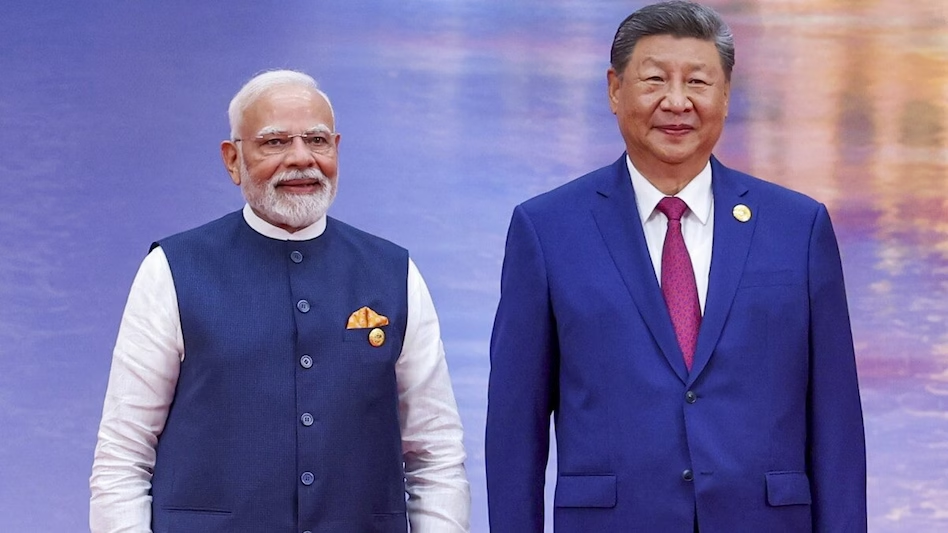
Chinese President Xi Jinping’s arrival in New Delhi for the September 12–13 BRICS summit offers India an opportunity to stabilize one of Asia’s most consequential relationships, but it should not be mistaken for evidence that the strategic rivalry between the two countries has ended. Xi’s first visit to India in seven years comes amid a tentative diplomatic thaw following the October 2024 agreement on patrolling arrangements at Depsang and Demchok, which enabled disengagement from the remaining friction points created during the 2020 border crisis. Direct flights, visas, pilgrimage routes and economic cooperation have gradually returned to the bilateral agenda. Prime Minister Narendra Modi has good reason to welcome dialogue: India and China are nuclear-armed neighbors, represent more than a third of humanity and possess deeply connected economies. Nevertheless, India must judge Beijing by its sustained conduct rather than summit declarations, ceremonial photographs or temporary disengagement agreements.
India’s caution is grounded in a long and difficult history. The 1954 Panchsheel Agreement promoted peaceful coexistence and became a symbol of postcolonial solidarity, yet less than a decade later India and China fought the 1962 border war, leaving a legacy of mistrust that has never been fully overcome. More recent confrontations include the 2013 Depsang standoff, the 2014 Chumar incident and the 2017 Doklam crisis near the India-Bhutan-China junction. Each episode was contained through negotiation, but each demonstrated how quickly conditions along the poorly defined Line of Actual Control could change. The gravest rupture came in June 2020, when Indian and Chinese troops fought in the Galwan Valley. Twenty Indian soldiers and at least four Chinese personnel were killed in the first fatal confrontation along the frontier in decades. Further clashes occurred near Tawang in Arunachal Pradesh in 2022. China continues to claim most of Arunachal Pradesh, which it calls “South Tibet,” while India regards the state as an integral part of its territory. India, meanwhile, maintains its claim to Aksai Chin, which China controls.
The October 2024 arrangements lowered the immediate danger but did not settle the boundary, remove the military infrastructure constructed on both sides or restore the conditions that existed before the 2020 crisis. India’s official position remains that peace and tranquillity along the frontier are essential to normalizing the wider relationship. Modi should therefore seek concrete and verifiable measures from Xi, including clearer patrol rules, dependable military hotlines, advance notification of significant exercises and steady progress toward a mutually acceptable boundary settlement. Another broad pledge to maintain peace will mean little if either country retains the ability to alter conditions on the ground without warning.
At BRICS, Xi is likely to emphasize that China and India are partners rather than rivals and that their differences should not define the entire relationship. The message has some merit. The two countries share interests in expanding the representation of developing nations, reforming international institutions, protecting strategic autonomy and advancing cooperation in trade, climate policy and development finance. But partnership rhetoric cannot conceal the reality that Beijing and New Delhi also compete for influence across South Asia and the Indian Ocean. China’s close military and economic relationship with Pakistan remains a fundamental Indian concern. The China-Pakistan Economic Corridor crosses territory claimed by India, while Chinese-funded ports and infrastructure projects have expanded Beijing’s presence around India’s maritime neighborhood. China’s growing navy, its operations in the Indian Ocean and its influence in countries surrounding India require continued attention. Cooperation through BRICS cannot replace border preparedness, maritime awareness or India’s partnerships with Japan, Australia, France, the United States and Southeast Asian countries. India should neither become dependent on China nor allow fear of China to compromise its strategic autonomy.
The economic relationship presents a striking contradiction: political confidence remains weak while bilateral commerce continues to reach record levels. Chinese figures placed two-way trade at approximately $155 billion in 2025, but India imports considerably more from China than it exports. Indian government data show that the trade deficit increased from $58.09 billion during April–October 2024 to $63.97 billion during the same period in 2025. India relies heavily on Chinese components and equipment for electronics, telecommunications, solar energy, pharmaceuticals, machinery and other industries. Many of these imports support Indian production and cannot be replaced quickly or cheaply, making abrupt economic separation unrealistic. Yet concentrated dependence becomes a national-security vulnerability when the principal supplier is also a strategic competitor. Beijing has demonstrated in its relations with other countries that it is willing to use trade restrictions, regulatory pressure and control over critical supply chains as instruments of state policy.
Modi should press Xi for greater access to the Chinese market, the removal of non-tariff barriers and measurable progress toward a more balanced commercial relationship. India must simultaneously diversify critical supply chains, develop domestic manufacturing and build partnerships with alternative suppliers. The objective should be resilience rather than indiscriminate protectionism or economically damaging isolation. Chinese investment may contribute to Indian growth, but proposals involving telecommunications, artificial intelligence, electricity networks, ports, mapping, semiconductors, personal data and other sensitive sectors require rigorous security scrutiny. India should be open to ordinary commerce while ensuring that economic integration does not give the Chinese state leverage over essential infrastructure or strategic decision-making.
The rivalry also reflects fundamental differences between the two states. India is a constitutional republic with competitive elections, opposition parties, a federal structure, an independent judiciary and formally protected fundamental rights. Its institutions are imperfect and frequently contested, but governmental legitimacy rests on popular consent, public accountability and constitutional limits. China is a one-party state governed by the Chinese Communist Party. Xi simultaneously holds the positions of state president, Communist Party general secretary and chairman of the Central Military Commission. Organized political opposition is prohibited, the media operate under party control and the judicial system is subordinate to the political leadership. These differences influence how the countries formulate policy, interpret agreements and respond to domestic pressure. Indian governments must answer to Parliament, courts, voters, state governments, journalists and public opinion. Chinese decisions emerge from a centralized party structure that provides foreign governments with limited visibility into its internal deliberations.
New Delhi should consequently avoid assuming that Beijing interprets sovereignty, transparency, law, accountability and international cooperation in the same manner as a constitutional democracy. At the same time, the moral difference between the systems should not be reduced to a simplistic assertion that every Indian action is virtuous or every Chinese action is malicious. India strengthens its position only when it remains faithful to its own constitutional ideals. It weakens its most important contrast with the CCP whenever peaceful dissent is suppressed, independent institutions are undermined, majoritarian politics overshadows equal citizenship or government decisions escape meaningful scrutiny. India’s credibility does not come merely from describing itself as the world’s largest democracy. It comes from demonstrating that national unity, development and security can coexist with individual dignity, political pluralism and government under law.
Tibet remains inseparable from both Indian security and the unresolved boundary dispute. The frontier is, in practical terms, largely India’s border with the Tibet Autonomous Region. Before the People’s Liberation Army established control over Tibet in the 1950s, the Tibetan plateau functioned as a geographical and political buffer. Its incorporation into the People’s Republic of China brought Chinese military power directly to India’s Himalayan boundary and permanently changed the regional balance. The Dalai Lama fled Tibet in 1959 and established himself in Dharamshala, where India continues to host him and a large Tibetan exile community. Beijing treats the Tibetan government-in-exile and most independent political activity associated with Tibet as separatism. India recognizes the Tibet Autonomous Region as part of China but permits Tibetan religious, educational and cultural institutions to operate on Indian soil.
Ahead of Xi’s visit, several Tibetan organizations appealed for renewed negotiations between Beijing and representatives of the Dalai Lama, while others rejected a conciliatory approach and planned protests. Talks between Chinese officials and the Dalai Lama’s representatives have been suspended for years. Tibetan advocates accuse Beijing of restricting religious practice, weakening Tibetan-language education, separating children from their communities through residential schools and suppressing cultural and political expression. Beijing argues that its policies have delivered economic development, modern infrastructure, poverty reduction and social stability. India need not endorse Tibetan independence to recognize that Tibetan cultural survival, religious freedom and meaningful autonomy are legitimate concerns that cannot be permanently silenced through security measures.
The eventual succession of the 90-year-old Dalai Lama is becoming the most consequential issue. Beijing insists that any reincarnation must be identified inside China and approved by the state, while the Dalai Lama and his followers maintain that a secular government particularly one committed to Communist Party control over religion cannot choose Tibetans’ spiritual leader. India cannot afford to treat this as a remote theological disagreement. A Beijing-selected Dalai Lama could be used to legitimize Chinese authority in Tibet and reinforce Beijing’s territorial narrative regarding Arunachal Pradesh, particularly the strategically and religiously important monastery town of Tawang. A rival successor recognized by Tibetan believers and based in India could produce an international religious and political confrontation lasting for decades. New Delhi therefore requires a clear policy before the succession begins rather than an improvised response after rival claimants emerge.
India should defend the ability of Tibetan Buddhists to administer their religious traditions without political coercion, protect peaceful Tibetan expression within India and preserve the humanitarian security of the exile community while preventing violence and maintaining diplomatic channels with Beijing. Tibet is also crucial because the plateau contains the headwaters of major rivers flowing into India, including the Brahmaputra. Chinese dams, hydrological data policies and upstream construction have direct implications for India’s ecology, agriculture and water security. Transparency, reliable data sharing and enforceable mechanisms for managing transboundary rivers should therefore form part of Modi’s discussions with Xi.
India cannot change its geography. China will remain a neighbor, a major commercial partner, a military power and an influential participant in every significant Asian institution. Permanent hostility would be dangerous and economically costly, but reconciliation based primarily on personal diplomacy would be equally hazardous. Modi and Xi held informal summits in Wuhan in 2018 and Mamallapuram in 2019, only for the Galwan confrontation to follow in 2020. The lesson is not that dialogue is futile, but that leader-level engagement must be supported by enforceable agreements, military preparedness, economic resilience and strong national institutions.
Modi should receive Xi with the courtesy appropriate to the leader of a neighboring state and cooperate wherever Indian interests are genuinely served. But New Delhi must remain wary of attempts to separate trade from border security, use BRICS solidarity to suppress legitimate Indian concerns or present temporary tactical accommodation as permanent strategic friendship. India’s strongest approach is neither hostility nor romanticism. It is disciplined engagement backed by national strength, constitutional confidence and historical memory.


